
Native American Heritage Month: A Different "Spin"
From LeBron's film support ... to Indian-owned banks and community/indigenous-led development

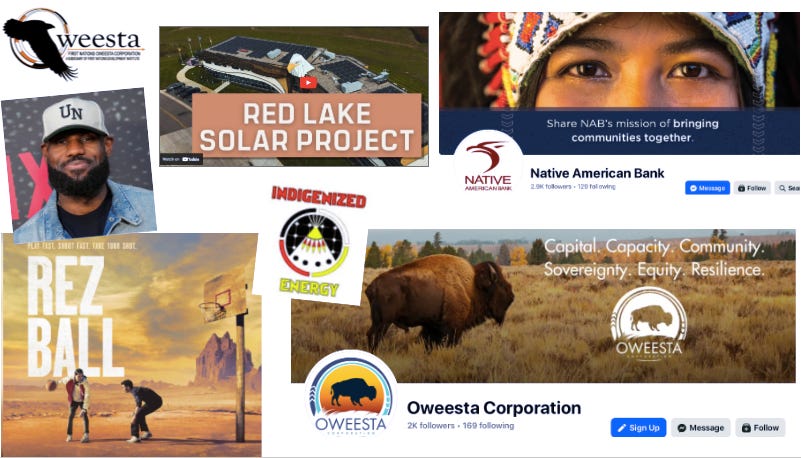

Yes, a nice “spin” for providing an inside look at First Nations experience: LeBron James produced “Rez Ball”, a film about Native American high school hoops. It’s written and directed by the same indigenous film makers behind the great 3-season teen comedy drama Reservation Dogs. So grab the remote and break out the popcorn for Turkey Day!
In this post, I’m consciously aiming to reverse course on the generally negative and depressing presentation of Native American issues. Like scores of Black folks, many indigenous people are tired of the bombardment of images and news of suffering and victimization. I found an interesting illustration of this in “Defy The Storm” - an intriguing ad campaign addressing pending federal cuts, but doing so via highlighting First Nations1 resistance and resilience.
Interestingly, I discovered that ad within INDIGENOUS EVERY DAY, an online unified Indian education and marketing campaign. It includes an effective 30-second “You Can Do Something” message; a listing of indigenous films and businesses; and the latest support campaign from the American Indian College Fund. (Fyi, I was very glad to find, separately, this article on increased enrollment at tribal colleges in California).
In my own work, some of the most inspiring examples I witnessed of effective, impactful community-driven economic development came from Indian Country. Three exciting initiatives I had the opportunity to fund while at the Ford Foundation: the Lakota Fund - supporting micro and small businesses within one of the country’s poorest regions; the Oweesta Fund - providing much-needed capital and technical assistance nationwide to promising Native-led commercial enterprises that are in turn becoming significant jobs producers; and Native American Bank - one of the few truly Indian-owned full-fledged banks in the country.
Contributing to the major growth of this work has been the Native Initiatives program under the federal Community Development Financial Institutions (“CDFI”) Fund - a highly effective government program that has become almost a movement, spawning from Bill Clinton’s belief in community banking and from the first CDFI conference - convened in 1993 in Durham, NC by my then organization Self-Help.
More recently, I have found community economic development inspiration in Indian Country from a series of bold and visionary Native leaders like Winona LaDuke and Bob Blake. Bob is an intriguing character (a former wanna’ be cop who was, at one point, bodyguard to Prince!!) with whom I got to work in the field of renewable energy. Bob’s projects are in the Minnesota Great Lakes region: Solar Bear solar installation (for the Red Lake Nation); Native Sun Community Power Development, a nonprofit - with a $7 million federal grant - leading innovative solar projects, workforce and public policy on Indian land in and surrounding Minnesota; and the Indigenize Energy Initiative, working nationally “to decolonize the energy and transportation system” and centering Indian communities in renewable growth, especially EV (electric vehicle) charging. Here’s a nice, short clip of Bob explaining some of his cutting-edge work, which is transforming local economies, fostering entrepreneurship and independence, and resurrecting cultural pride and dignity.
Obviously, the current federal shi_-storm poses serious challenges to these projects. Furthermore, all successes noted here must be understood in the context of an overall condition for First Nations communities that warrants our continued concern, and education. Here are two great starting points for that learning: a short video interview of the brilliant Lakota historian Nick Estes; and a great curriculum of resistance provided by the Zinn Education Project. (Other good resources are listed below).
Of course issues are only exacerbated by the sickness of the current federal administration:
The disproportionate negative impact of the federal shutdown -

The MAGit vile desecration of those massacred in 1890 at Wounded Knee
and erasure of reporting on missing and murdered indigenous people.
Yet “Defy The Storm” we must. And Native American communities continue to demonstrate perseverance and resilience.
Forward Ever!
Additional Resources:
Wikipedia provides a good summary of the many ills still beset upon our First People and is a good source for basic info such as the current Native population being nearly 3 million, with one-third concentrated in three states - California, Arizona, and Oklahoma - and the vast majority being in urban areas (70% in 2012, up from 45% in 1970 and 8% in 1940).
Media:
Native America - podcast by Rebecca Nagle
Red Hoop Talk - Association on American Indian Affairs
Organizations:
I strive in this piece to respect varying perspectives on the naming challenge/controversy - e.g. “Native American” / “American Indian” / “Indigenous” / “First Nations - which is further discussed in this interesting Wikipedia post.
Thanks for writing this, it clarifies a lot, illuminating the critical importance of narrative sovereignty in indigenous representation.
Great piece, as always Mitty. Strong work for funding those initiatives. We can all take a page from your book!