
This Spring: I’m choosing INTERFAITH “Justice and Joy”
(...for might a sole focus on Passover be a furtherance of Jewish Supremacy?)

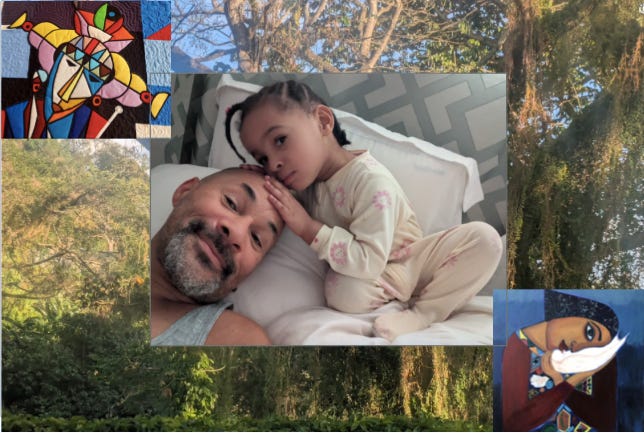
With Spring comes Easter, Passover and Ramadan. And for this - also overlapping with my birthday (March 26 - the day and same year, 1964, of the one known meeting of Martin and Malcolm!) - I’m choosing an interfaith and humanist celebration of “Justice and Joy.”
Though my brothers and I were raised secular, a special annual event was our Black-Jewish Liberation Seder (see my piece Our Jewish Mama: Supporting Jewish Humanity); and it’s been sweet that my daughter Naia has, since her grandma’s passing in 2020, taken interest in trying to keep that tradition alive in our family. But honestly, though I and the peace movement underscore the distinction between Judaism and Zionism, I’ll admit to my strong ambivalence about celebrating anything Jewish right now.
While I know that’s wrong, there is validity in unpacking some underlying and related issues, i.e. the hyper-emphasis on the historic Exodus and the modern-day atrocities of Hitler as if Jews are the only people who have suffered so greatly – belittling and even erasing from common knowledge the many other holocausts, and furthering a problematic notion of one group of people as “the chosen” ones.
Rather, my upcoming Justice and Joy celebration aims to foster greater understanding of Ramadan and Eid, and of the deeper and broader meaning of Easter with all of its indigenous and pagan influences surrounding rebirth and the sanctity of life. For undoubtedly, our profound societal ignorance and xenophobia towards Islam and other traditions partially underlies our disregard for their value and humanity.
But our current horrid situation is fueled also by a desecration of Judaism - an imposition of materialist consumerism and, well, yes, capitalism!, over the truly sacred such as Judaism’s call for “Tikkun Olam,'“ meaning doing good in the world. While this principle is still evident in extensive Jewish philanthropy and in historical alliances around civil rights, Jewish prominence and influence has come increasingly to mirror the general values of our society. Greater pride is taken in the cost of the bar mitzvah than the meaning behind it. A concentration of wealth goes to building Jewish institutions. And massive resources are committed to Israel - with Michael Bloomberg alone giving over $70 million in just the last 2 years.
In fairness, such transgressions from original religious teachings appear to be a tendency of many groups. Witness the opulence among many Islamic leaders, with some driving severe class disparities, perpetuating monarchies, exploiting migrant workers, suppressing human rights, and building up huge militaries.
Interestingly, some religious traditions do have elements built in to at least question such injustices, and to prize charity and the sharing of wealth (e.g. Eid al-Fitr, or the Native American “potlatch”). Yet all of the prominent Judeo-Christian-Muslim faiths appear to fall far short of calling explicitly for a social justice imperative of distribution and equity, or of actively opposing violence and cruelty. Unless I’ve missed something, there is no clearly articulated sin around economic exploitation – a “thou shalt not live well while denying one’s workers a living wage and the benefits required for a dignified life”; or a “thou shall not steal another’s people as slaves, their natural resources or land, even in the name of religion or an alleged righteous cause.”
Think of it. Adherence to holy principles such as these would have changed the course of history.
So, rather than perpetuate the privilege of a western predominant Judeo-Christian tradition, or even more fundamentally, a notion of the loftiest values being held only by those who claim religion, here’s to learning a bit more of the multiplicity of life-affirming beliefs - whether from clerics, healers, revolutionaries, or our kind neighbors - that with sincerity and passion may serve the wretched of the earth and make a better world possible.
Ashé … Shalom … Salaam … Ayibobo (Vodun/Haitian Creole) … Kulamosi (Lenape)
Here’s to the embrace of the sanctity of life for us all!
(And I’ll let you know how Justice and Joy goes!)
When I was a child, maybe 10 or 12 I was given a book as a gift probably for Christmas. It was called The Book Of The Golden Rules. Basically the 10 commandments and when I decided I was going to run away from home that was all I took with me. It was my road map for acceptable human behavior. I don’t know that my principles have become any more sophisticated since then. Treat others as you yourself want to be treated, everyone is equal …. etc….
Aside from the Christmas tree we had been raised with a menorah in our front window during the holidays and my brothers and I would fight each night over who got to turn on the electric bulb for we were possibly one of the lost tribes of Isreal. She would tell us often about reading the Koran as a young girl though I don’t remember any of her thoughts from it. Maybe once a month my mother would send my brothers and I to Sunday school “she said to have a good foundation and understanding of religion and when I was 12 we were given the choice to choose any religion we wanted, we just couldn’t become Catholics because she felt there was too much guilt involved.
I went to Sunday services for a while after that to see what I felt now that it was my decision and settled on the Sunday they did baptisms. There was a full pool under the pulpit and as the congregation was dressed in white all singing wading in the water the person was embraced and fully immersed in the water. I think I loved the whole sense of community about it but in the end decided religion wasn’t for me. It was too divisive with its differences. In college my older brother described me as a humanist and I think I’ll stick with that once again not far from the book of golden rules. I still see the look of startled surprise on my mother’s face when I told her I was an atheist and she said you mean agnostic and said no atheist. The look on her face was that of someone who had been betrayed. But I feel that without the restrictive “skins” of religion it's easier to see one another as equals, to feel responsible for each other’s wellbeing and celebrate spring as a time of renewal and rebirth and rejoining of our humanity towards one another.
Mitty,
Your heartfelt and thought provoking post sets a high bar of self reflection and is appreciated but difficult to match. I can't reconcile the term progressive Zionist. Also, I don't feel comfortable weighing in on what a solution is. But a secular. Framework is obligatory.
I applaud your grappling with these issues and wish you mucho ashe and solidarity this Spring! And much love as is evident in the photo you shared
Peace,
Angel